
Difference Between Bits and Qubits

Difference Between Bits and Qubits
In this tutorial, let’s examine the difference between bits and qubits. Understanding this is important for understanding the basics of Quantum computing.
Bit
A bit (short for binary digit) is the smallest unit of data in classical computing. It can represent one of two possible states: 0 or 1.

Qubit
A qubit (quantum bit) is the basic data unit in quantum computing. Unlike bits, qubits can represent both 0 and 1 simultaneously due to the principle of superposition in quantum mechanics.
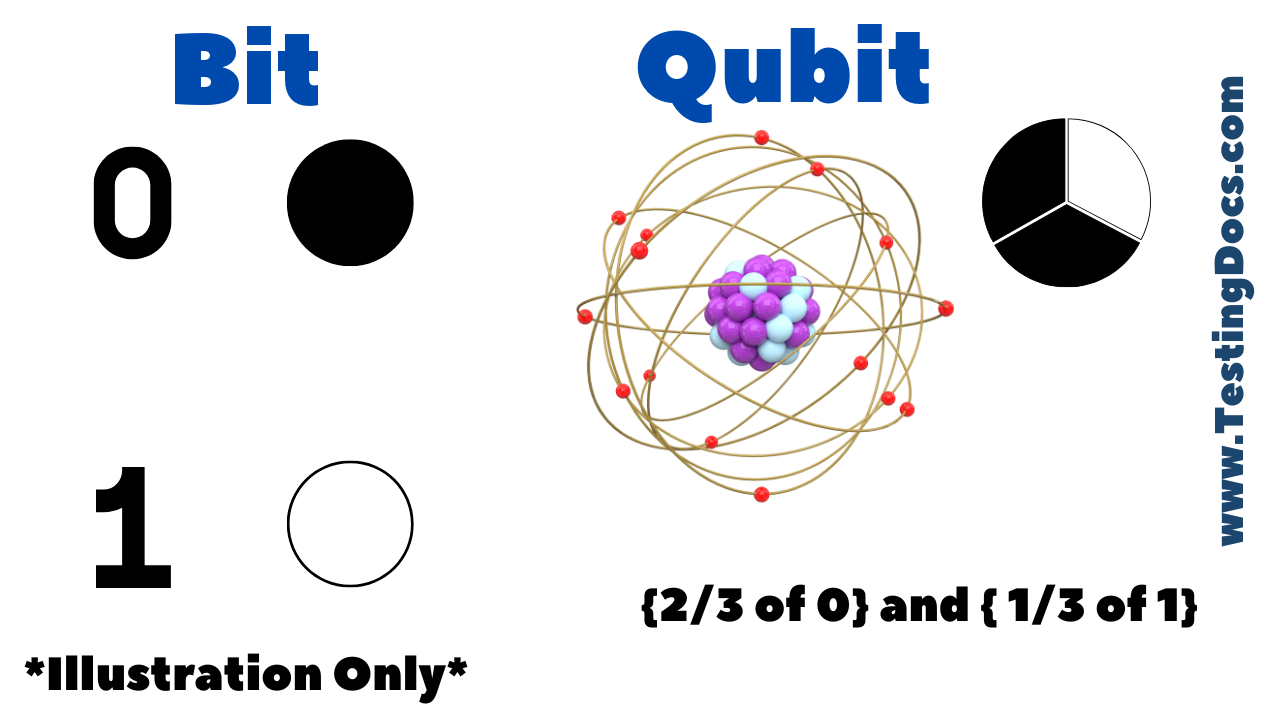
State of a qubit
Using Linear Algebra, the state of a qubit
ψ=a|0⟩+b|1⟩ is described as a quantum state vector [a b],
where |a|^2+|b|^2=1
Bit vs Qubit
Some of the differences between bit and qubit are as follows:
| Bit | Qubit | |
|---|---|---|
| Definition | A bit is the smallest unit of data in classical computing, representing either 0 or 1. | A qubit is the smallest unit of data in quantum computing, which can represent both 0 and 1 simultaneously due to superposition. |
| Possible States | 2 states (0 or 1) | Infinite possibilities within a range due to superposition (0, 1, or any combination in between) |
| Computation Type | Classical computing (deterministic) | Quantum computing (probabilistic) |
| Superposition | No superposition must be in one state at a time. | Yes, a qubit can exist in multiple states at once (both 0 and 1). |
| Entanglement | No concept of entanglement. | Qubits can be entangled, meaning the state of one qubit can depend on the state of another, even over long distances. |
| Usage | Used in traditional computers for tasks like calculations, storage, and data processing. | Used in quantum computers to perform complex calculations that are difficult for classical computers, such as simulating quantum systems or cryptography tasks. |