
Mathematical Induction : Sum of N natural number squares

Mathematical Induction : Sum of N natural number squares
Using Mathematical Induction Prove that the sum of the first n natural number squares is:
i.e
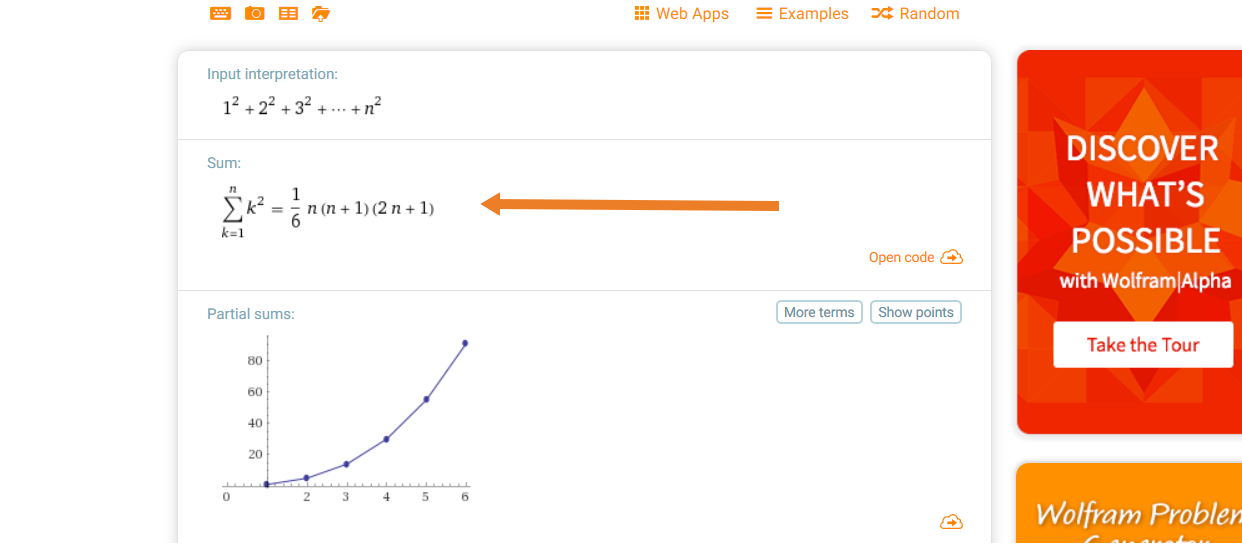
Using WolframAlpha to find the formula. WolframAlpha is a great mathematical computational tool for Mathematical students.
- https://www.wolframalpha.com/
Proof
By Mathematical Induction.
Base case : P(1)
Let’s prove that the base case holds true. We need to show that P(1) is true.
1=1
P(1) is true.
Induction Case
Let’s assume that P(k) hold true. Assume that for some positive k, P(k) holds true, so that
P(k)
We need to show that P(k + 1) holds true.
We have assumed that P(k) is true. Replacing for k terms we get:
Taking (k+1) common we get :
Take hints in the factorization, we need to prove and eventually get (k+1) in terms of k.
expand and rearrange the 2nd term:
Taking k+2 common
Hence P(k + 1) holds true, when P(k) is true, so P(n) is true for all finite natural numbers n.