
How to Fix JUnit Invalid test class Error

How to Fix JUnit Invalid test class Error
Exception Trace
org.junit.runners.model.InvalidTestClassError: Invalid test class ‘com.testingdocs.tutorials.TestCaseOne’:
1. The class com.testingdocs.tutorials.TestCaseOne is not public.
2. Test class should have exactly one public constructor
at org.junit.runners.ParentRunner.validate(ParentRunner.java:525)
at org.junit.runners.ParentRunner.<init>(ParentRunner.java:102)
at org.junit.runners.BlockJUnit4ClassRunner.<init>(BlockJUnit4ClassRunner.java:84)
at org.junit.runners.JUnit4.<init>(JUnit4.java:23)
The error message suggests that your JUnit test class has incorrect visibility or constructor issues.
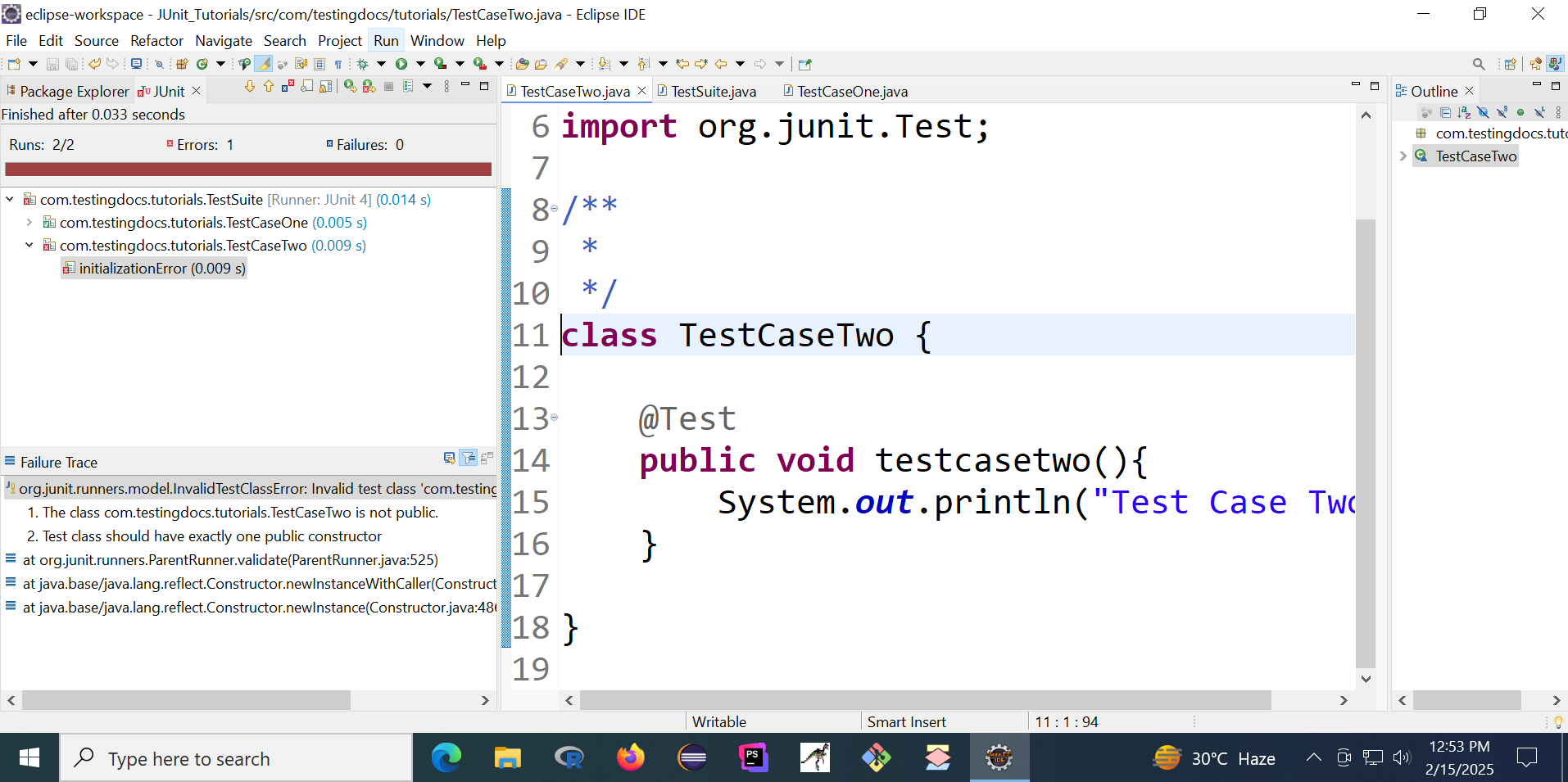
Possible Fixes
Ensure the Test Class is Public
Your test class must be declared as public:
package com.testingdocs.tutorials;

import org.junit.Test;
import static org.junit.Assert.assertTrue;

public class TestCaseOne {  // Ensure the class is public

    @Test
    public void testExample() {
        assertTrue(true);
    }
}
Ensure There is Only One Public Constructor
JUnit test classes should have only one public constructor. If you have multiple constructors, remove the extra ones.
Incorrect:
public class TestCaseOne {
    public TestCaseOne() {}  // Default constructor (OK)
    public TestCaseOne(String param) {}  // Extra constructor (INVALID)
}
Correct:
public class TestCaseOne {
    public TestCaseOne() {}  // OK
}
Ensure JUnit is Using the Correct Runner
If you are using JUnit 4, add the correct runner annotation:
import org.junit.runner.RunWith;
import org.junit.runners.JUnit4;

@RunWith(JUnit4.class)
public class TestCaseOne {
    @Test
    public void testExample() {
        assertTrue(true);
    }
}
For JUnit 5 (Jupiter), no runner annotation is needed:
import org.junit.jupiter.api.Test;
import static org.junit.jupiter.api.Assertions.assertTrue;

public class TestCaseOne {
    @Test
    void testExample() {
        assertTrue(true);
    }
}
Ensure the Test Class is Not a Nested (Inner) Class
If your test class is an inner class, it must be static:
public class OuterClass {
    public static class TestCaseOne {  // Must be static
        @Test
        public void testExample() {
            assertTrue(true);
        }
    }
}
Final Checklist
- ✅ Class is
public - ✅ Only one (or no) constructor
- ✅ No extra constructor parameters
- ✅ Proper
@Testannotations - ✅ Using correct JUnit version
After applying these fixes, try running the test again.